Written by Jason Falkenburg
Jason A. Falkenburg, PhD, is an experimental curator; his projects explore how exhibitions can function as living laboratories that connect art, archaeology, heritage, and environmental awareness.
A reader’s guide note: viewed through an art-archaeological curatorial lens, this essay underscores the value of heathlands as living landscapes of natural and cultural heritage – archives of long-durée human engagement – and advocates for their existence and preservation amid human-induced “anthropocenic” affliction.

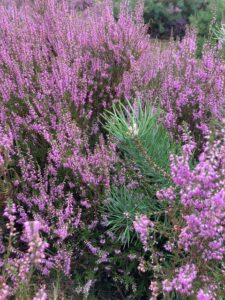
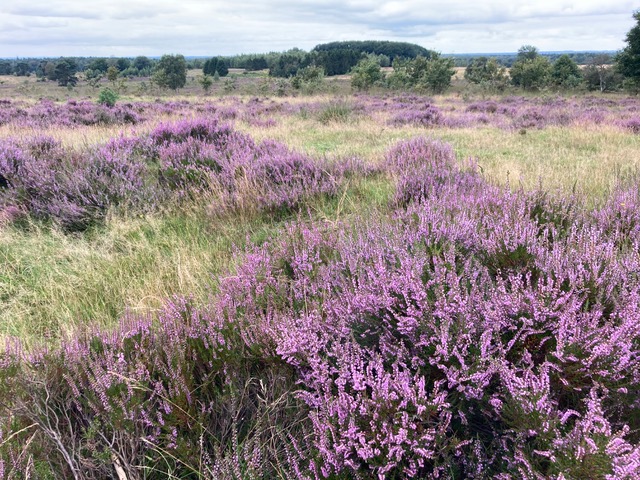
Photos by author: “Kootwijker Heathland” (Gelderland, NL)
What Are Heathlands, and Why Do They Matter?
If you’ve ever wandered across a windswept landscape, not far from the coast, where purple heather stretches beneath an open sky, you’ve stepped into one of Europe’s quiet miracles: the heathland. These wide, low-growing environments, filled with heather, gorse, and tough grasses, have existed for thousands of years. But they are not untouched wilderness. Heathlands are living records of human care, intervention, and adaptation. Generation after generation, people have cut, grazed, and burned these lands in rhythm with the seasons, keeping them open and alive. Without that steady care, the heath would quickly close in, turning back into forest. In other words, heathlands – for the most part – only exist because people tended them. They are one of Europe’s oldest examples of a shared landscape of nature and culture intertwined. From the honey made by bees feeding on heather to the traditional brooms, dyes, and medicines made from its bulbs and stems, heather has woven itself into daily life for millennia. Today, however, these landscapes are vanishing. Across northwestern Europe, heathlands are shrinking into isolated patches as cities grow, farmlands expand, and climate change accelerates. The loss is not just ecological – it is cultural. The stories, practices, and memories that link people to these environments are disappearing too. So how can we help people see what is slipping away, especially when the change happens slowly, almost invisibly? That question lies at the heart of my experimental art installation Visions from the Future.
The Challenge of Seeing Slow Disappearance
Environmental change rarely arrives all at once. It creeps. A few fewer bees each summer. A little less purple on the hillsides. A patch of heath replaced by scrub. For most of us, that slow fade is hard to notice, and harder still to feel. As a curator and researcher, I’m fascinated by how museums, archaeology, and art can make that invisible process tangible. Can an exhibition help us see time passing? Can an artwork help us feel what it means to lose a landscape? Artists have always experimented with representing change. In Japan, Zen gardens made of sand and stone invite visitors to meditate on movement that isn’t really there – the flowing lines of a rake that stand in for rivers and waves. These gardens are not entered but viewed from a veranda, encouraging reflection and calm attention. I wanted to borrow that same quiet intensity for my own project: a space that asks visitors not just to look, but to pause and imagine.
Visions from the Future: An Installation About Disappearing Heathlands
Visions from the Future is an imagined landscape of three interlinked compositions that trace a story of change and disappearance. Spread across the ground like a garden viewed from above, the installation envisions a future in which heathlands survive only as archaeological-museum relics.
Composition I – The Ocean of Plastics
The first scene looks like an abstract seascape – a swirl of blues, whites, and flashes of color forming a spiral pattern. At first glance, it’s beautiful, almost hypnotic. Then the visitor realizes that the colors are fragments of real ocean plastics, gathered and crushed into powder and paint. The spiral recalls the swirling currents of the North Atlantic, where floating waste collects into a massive “garbage patch.” Scientists now know that these plastics can break down into tiny airborne particles – what some call “plastic rain.” It falls back onto land, even onto remote heathlands. My first composition visualizes this connection: an invisible exchange between ocean pollution and fragile terrestrial ecosystems. The swirling design is both mesmerizing and unsettling, reminding viewers that what happens far out at sea can return to touch even the most ancient landscapes.

Pencil Sketch Idea (I)
Composition II – The City in Ruins
Moving along the installation, the next section shifts from water to land – an imagined futuristic city collapsing under its own weight. The ground is covered in fragments of metal, glass, and concrete, the remains of skyscrapers eroding back into dust. It looks like a mosaic of modern life after it has ended. Here, visitors witness how human expansion and urbanization consume the natural world. Rising seas from the previous composition spill into this one, symbolizing how ocean and land crises are intertwined. The broken city is not just a ruin; it’s a mirror of our own moment, asking: what happens when progress outpaces care? The atmosphere is strangely serene. Even in destruction, the shapes shimmer with beauty. That tension – between attraction and discomfort – is intentional. It reflects how environmental harm often hides beneath aesthetics we admire: shining cities, smooth surfaces, technological wonder.

Pencil Sketch Idea (2)
Composition III – The Last Heathland
The final scene feels quieter. A dark, barren ground stretches before you. Three small hills of living heather stand alone, each at a different stage of life: one in bloom, one withered, one decaying. Together they tell a simple story – the biography (past and future) of a landscape. At the center stands a small cylindrical structure: a museum of the future. Inside are preserved heather plants and seeds stored in jars, a gesture of hope that something perhaps can still be saved. The seeds glow softly with bioluminescent pigment, recalling the curiosity cabinets of early science when people collected and displayed natural wonders to understand the world. Here, the viewer can step inside, hear the crunch of soil underfoot, and look closely at the specimens. The effect is both intimate and haunting. It asks: what would it mean if the only place to encounter a heathland were inside a museum display?

Pencil Sketch Idea (3)
From Wonder to Awareness
The idea behind Visions from the Future is not only to mourn what’s disappearing but to awaken a sense of wonder. Wonder has always been central to learning — it’s the spark that makes us stop and ask why. In museums, that moment of wonder can shift from curiosity to care. The small “museum of the future” in my installation borrows from the old tradition of the cabinet of curiosities, those early collections where scholars and explorers gathered shells, fossils, and mysterious objects from around the world. These cabinets weren’t just displays; they were tools for thinking. They helped people imagine connections across nature, art, and science (even religion). By reviving that spirit, the installation invites visitors to see heathlands not as static habitats but as dynamic stories of coexistence. They remind us that landscapes are living archives of human action – records of how people have shaped and been shaped by their environment for thousands of years. Experimental art can help us read those archives differently. It translates data and theory into experience. Where reports and graphs describe loss in numbers, installations can make that loss felt in the body: the texture of crushed plastic, the fragility of dried heather, the eerie quiet of an empty landscape.
Archaeology and Deep Time
Archaeology reminds us that every landscape is a layered record of human life. Beneath the surface of heathlands lie traces of past activity – ancient grazing routes, charcoal from Neolithic fires, fragments of tools and pottery. These clues show that heathlands are not just natural habitats but long-term human creations, shaped through centuries of practice and care. In Visions from the Future, this archaeological awareness informs how the installation is built. Parts of the composition can be read as a kind of “stratigraphy,” a visible layering of human traces across time: plastic waste and modern ruins on top, the living heather below. Just as archaeologists interpret soil layers to reconstruct forgotten worlds, visitors can “read” the installation to uncover how human actions accumulate, leaving both beauty and damage in their wake. By blending art and archaeology, the project invites viewers to think across timescales – from ancient heathland management to the environmental futures we are now creating. It turns the exhibition floor into a kind of open excavation site, where imagination becomes a tool for discovery.
Why Experimental Curation Matters for Heritage Communication
Museums are changing. Once focused on objects and the past, they are now becoming spaces where we can confront the challenges of the Anthropocene and reflect on how human activity continues to alter the planet’s fragile ecology. Yet these issues often unfold too slowly or too abstractly for visitors to grasp through traditional displays. That’s where experimental curation can help. By combining research, design, and story, experimental exhibitions can transform heritage learning into a participatory act. They invite visitors to reflect, imagine, and even co-create meaning. My approach – treating exhibitions as “living laboratories” – aims to make museums spaces of inquiry rather than authority. In Visions from the Future, heathlands become more than a topic of ecological concern; they become a way to think about time, care, and continuity. Viewers don’t just receive information – they inhabit it. The installation asks them to look, walk, and wonder. It turns environmental data into a shared emotional experience. For young audiences, this approach can be especially powerful. It encourages creative engagement rather than passive observation. It shows that heritage isn’t only about the past — it’s about choices we make in the present and futures we can still shape.
Learning Takeaways
By exploring disappearing heathlands through art, readers and visitors can learn:
- Interdependence: Heathlands exist because of long human–nature cooperation
- Perception: Slow environmental change is often invisible. Art can make that change visible and emotionally resonant.
- Care through Creativity: Experimental exhibitions use design and imagination to foster ecological empathy.
- Hope: Even in scenarios of loss, creative practices can preserve memory and inspire action.
For Educators and Learners
Discussion questions:
- What does it mean to “preserve” a landscape? Can we collect it the way we collect objects?
- Why do you think artists use beauty to talk about environmental problems?
- How does wonder help us learn about the world?
Activity Prompt:
- Create your own mini museum of the future.
- Collect three small natural or everyday objects that might disappear in the next 50 years.
- Arrange them in a box or on a table as a display.
- Write short labels for each: what is it, where did it come from, and why might it matter in the future?
Reflect: How does displaying these objects change the way you see them?
Closing Reflection
Heathlands are fading, but their story continues. Each patch of heather, each grain of sand, each visitor who pauses to wonder carries a fragment of that story forward. Art can’t stop landscapes from changing, but it can help us see the change – and perhaps inspire us to act before the silence grows too wide. Through Visions from the Future, I hope to remind audiences that caring for heritage begins with imagination. If we can imagine loss, we can also imagine renewal.

** I’m not a painter by any means, but I decided to have some fun and try expressing the installation idea through an impressionistic acrylic painting.
Further Reading
Allen, D., Allen, S., Le Roux, A., Simonneau, G., Galop, A. and V.R. Phoenix. 2021. Temporal Archive of Atmospheric Microplastic Deposition Presented in Ombrotrophic Peat. Environmental Science & Technology Letters 8(11): 954-960. DOI: 10.1021/acs.estlett.1c00697.
Godin, G., Pétursdóttir, Þ., Praet, E., and J. Schofield. 2024 eds. The Routledge Handbook of Archaeology and Plastics. London: Routledge.
Fagundez, J. 2013. Heathlands confronting global change: drivers of biodiversity loss from past to future scenarios. Annals of Botany 111(1): 151–172, doi:10.1093/aob/mcs257.
Løvschal, M. 2021. Anthropogenic heathlands: disturbance ecologies and the social organisation of past super-resilient landscapes. Antiquity 95 (381): 1–6 ,doi.org/10.15184/aqy.2021.46.
McGovern, S. 2004. The Ryoan-Ji Zen Garden: Textual Meanings in Topographical Form. Visual Communication 3(3):344-359. DOI:10.1177/1470357204045787.
Mitman, G., Armiero, M., and R.S. Emmett. 2018. Future Remains: a cabinet of curiosities for the Anthropocene. Chicago: The University of Chicago Press.
Russell, I. and A. Cochrane. 2014. Art and Archaeology: Collaborations, Conversations, Criticisms (Vol. 11, One world archaeology). New York: Springer New York.